


Emotional resilience isn’t some magic trait you’re born with. It’s a skill, plain and simple: a practical ability to handle stress and bounce back from whatever life throws your way. Think of it as a mental toolkit you can build over time, piece by piece.
At its core, it comes down to a few key areas: tuning into yourself (self-awareness), challenging the stories you tell yourself (reframing your thoughts), learning to manage your emotional reactions (regulating your emotions), and leaning on others (strong social connections).
What Is Emotional Resilience and Why It Matters Now
Ever feel like you’re drowning in deadlines, personal demands, or just one piece of bad news after another? That feeling isn’t just a “bad day.” It’s the reality for many of us in an increasingly fast-paced world.
Emotional resilience is what allows you to navigate those storms. It’s the capacity to bend without breaking and to come out of a tough time stronger than before.
This isn’t about ignoring your feelings or just “toughing it out.” It’s the exact opposite. It’s about having the skill to acknowledge difficult emotions, process them in a healthy way, and keep moving forward with a sense of purpose. It’s that quiet strength you see in someone who gets laid off but uses it as a chance to find more meaningful work, or a friend who grieves a loss while still finding moments of joy and connection.
The Growing Need for Resilience
In a world that feels more uncertain than ever, the ability to cope has become a fundamental life skill. Global stress levels are on the rise, making the practice of building resilience more critical than ever. We’re all feeling the pressure, but we also have an incredible, built-in capacity to adapt.
The data paints a clear picture. One massive analysis covering over 2.4 million people in 122 countries found that psychological stress shot up by an average of 12.5% per country during the COVID-19 period compared to the 2008 financial crisis.
Similarly, the 2023 Mental State of the World report showed that only 38% of people felt they were “Succeeding or Thriving” mentally. But here’s the hopeful part: that same report found that Adaptability and Resilience is one of our strongest mental skills worldwide. This suggests that even when we’re under strain, our natural ability to adapt is still kicking. Learn more about these global resilience findings.
This is great news. It tells us that while the world might be throwing more at us, we have an internal resource that we can actively strengthen.
Emotional resilience isn’t about avoiding life’s storms. It’s about learning how to build a stronger ship, rig the sails, and navigate the waves with confidence, knowing you have the skills to reach calmer waters.
The Four Pillars of Emotional Strength
So, how do you actually build this skill? It boils down to working on four core areas. Each one supports the others, creating a solid foundation for your mental well-being.
Before we dive into the specific exercises, let’s get a clear look at these four pillars. They are the foundation of everything we’ll be working on.
| Pillar | What It Is | Your First Action Step |
|---|---|---|
| Self-Awareness | The ability to recognize your own emotions, thoughts, and behaviors without judging them. It’s the starting point for everything else. | At the end of the day, just ask yourself: “What was one emotion I felt strongly today, and when did I feel it?” |
| Cognitive Reframing | The practice of identifying unhelpful or negative thought patterns and consciously shifting your perspective to be more balanced and constructive. | The next time you catch yourself thinking a worst-case scenario, ask: “What’s a more likely or positive outcome?” |
| Emotional Regulation | The skill of managing your emotional responses. It’s about responding to situations thoughtfully instead of reacting on impulse. | When you feel overwhelmed, take 3 slow, deep breaths. Focus only on the air moving in and out. |
| Strong Social Connections | Nurturing supportive, healthy relationships that provide a buffer against stress and a source of strength during tough times. | Send a text to one friend you haven’t spoken to in a while, just to say you’re thinking of them. |
Understanding these pillars gives you a clear roadmap. By focusing on these four areas, you can start building a resilient mindset that empowers you to thrive, no matter what comes your way.
Building a Foundation with Daily Resilience Habits
Emotional resilience isn’t something you’re born with, and it certainly isn’t forged in a single, dramatic moment. It’s built quietly, brick by brick, through the small, consistent actions you take every single day. These foundational habits become your mental and emotional anchor, giving you stability long before a storm ever hits.
Think of it like physical health. You don’t get strong by hitting the gym once a year for an eight-hour marathon session. You get strong by showing up for 30 minutes, a few times a week, over and over again. Building emotional resilience works the same way: it’s about weaving simple yet powerful practices into your daily rhythm.
This journey usually follows a clear path, starting with awareness and moving toward regulation and connection.
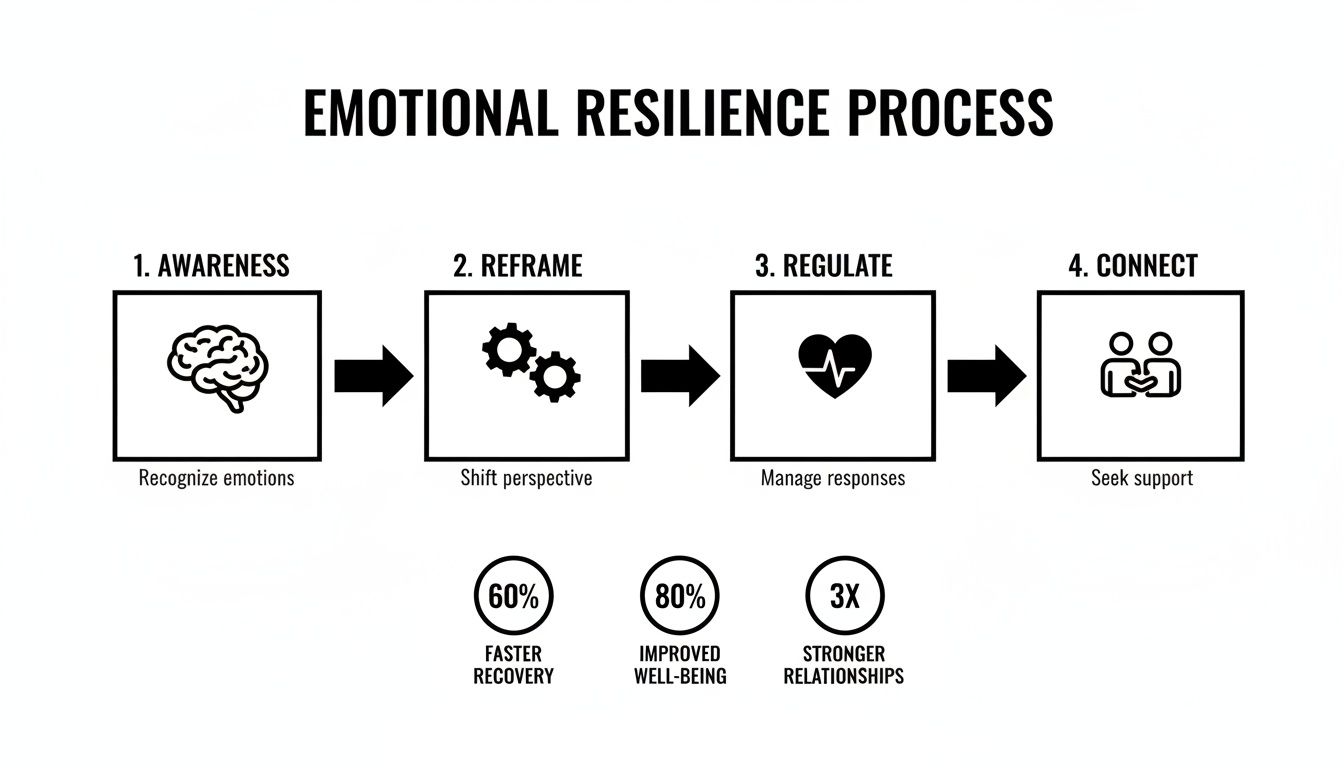
This process breaks down into four key stages: becoming aware of your internal state, reframing your thoughts, regulating your emotional response, and connecting with others for support.
Start with Mindful Breathing
When stress hits, your sympathetic nervous system kicks into high gear, triggering the classic “fight or flight” response. Your heart races, your breathing gets shallow, and your mind feels cloudy. Simple, controlled breathing exercises are your direct line to calming this system down.
They work by activating your vagus nerve, which helps slow your heart rate and sends a signal to your brain that you’re safe. Two incredibly effective techniques you can use absolutely anywhere are Box Breathing and the 4-7-8 Method.
- Box Breathing: Inhale for a count of four, hold for four, exhale for four, and hold again for four. Repeat this cycle for a minute or two.
- The 4-7-8 Method: Inhale through your nose for a count of four, hold your breath for seven, then exhale completely through your mouth for a count of eight.
These aren’t just little relaxation tricks; they are physiological resets. Practicing them for just a few minutes each day, even when you’re calm, trains your body to respond more effectively when you actually need it.
Practice Daily Emotional Check-Ins
Just as you might check the weather before leaving the house, getting into the habit of checking in with your emotional state is a form of essential mental hygiene. This is all about building self-awareness, which is the absolute cornerstone of resilience. If you don’t know what you’re feeling, you can’t even begin to manage it.
This doesn’t need to be complicated. Just take five minutes each day to sit with a journal and reflect.
An emotional check-in isn’t about judging your feelings as good or bad. It’s about acknowledging them with curiosity. This gives you the power to choose your response rather than being driven by unchecked emotions.
Let’s look at a real-world scenario. Sarah, a project manager, has been feeling irritable and unfocused at work. Instead of just pushing through it, she starts a five-minute journaling practice each morning.
One day, she writes, “Feeling anxious and tight in my chest.” By simply naming it, she realizes her anxiety isn’t about her workload in general but about a specific upcoming presentation. This awareness allows her to take a targeted action, like practicing her slides, instead of letting a vague sense of unease ruin her entire day. For more practical guidance, you can explore our detailed article on how to improve self-awareness.
Prioritize Your Physical Foundation
You cannot build a resilient mind in a depleted body. It’s just not possible. Sleep and nutrition are the non-negotiable pillars of your emotional stability. Chronic sleep deprivation tanks your judgment and emotional regulation, making you far more susceptible to stress.
Research consistently shows a direct link between poor sleep quality and lower resilience. Aim for 7-9 hours of quality sleep per night. To make this happen even with a busy schedule, try these small adjustments:
- Set a consistent bedtime and wake-up time, even on weekends. Your body loves a routine.
- Avoid screens for an hour before bed. The blue light can interfere with melatonin production.
- Create a simple wind-down routine, like reading a book or listening to calm music.
Similarly, what you eat directly impacts your mood and energy. A diet high in processed foods and sugar will lead to energy crashes and heightened irritability. Focus on whole foods like fruits, vegetables, and lean proteins to keep your blood sugar, and by extension, your mood, stable throughout the day. Integrating these small habits is the key to creating a strong foundation for lasting resilience.
Using Cognitive Tools to Reframe Your Mindset
Our internal narrative is powerful. The stories we tell ourselves about our experiences don’t just describe our reality; they actively create it. Building emotional resilience often starts with learning to become the editor of this internal story, shifting your perspective from one that drains your energy to one that empowers you.
This is where cognitive tools come into play.

These tools help you catch and challenge the automatic negative thoughts that often run on a loop in the background of your mind. By mastering your mindset, you can transform how you experience and respond to life’s challenges, making it a cornerstone of building real, lasting emotional resilience.
Identifying Unhelpful Thought Patterns
Before you can change your thoughts, you have to notice them. Many of us fall into common negative thinking traps, also known as cognitive distortions, without even realizing it. These patterns can fuel feelings of anxiety and hopelessness, making it much harder to bounce back from setbacks.
Here are a few common ones to watch out for:
- Catastrophizing: This is when you immediately jump to the worst-case scenario. A friend doesn’t text back, and your mind declares, “They must be angry with me,” instead of considering they might just be busy.
- All-or-Nothing Thinking: You see things in black-and-white terms. If a project isn’t perfect, you view it as a total failure, leaving no room for nuance or partial success.
- Personalization: This is when you take things personally or blame yourself for events that aren’t entirely your fault. If a team project struggles, you might think, “It’s all my fault,” ignoring all the other contributing factors.
Learning to spot these patterns is the first, most important step. When you can recognize a thought as a distortion instead of a fact, it instantly loses much of its power over you. If these patterns feel especially intense, our guide on how to overcome fear and anxiety offers more strategies that can help.
The Power of Cognitive Reframing
Once you can identify these negative thoughts, the next move is to actively challenge and change them. This practice is called cognitive reframing. It’s not about pretending everything is perfect or forcing toxic positivity. It’s about finding a more balanced, realistic, and constructive perspective.
Let’s walk through a real-world example. Imagine you just received some tough feedback at work.
- Identify the Automatic Thought: Your immediate thought might be, “I’m terrible at my job. I’m going to get fired.” (This is a classic mix of catastrophizing and all-or-nothing thinking).
- Examine the Evidence: Ask yourself, “What’s the evidence for and against this thought?” You might recall past successes, positive reviews, or moments of praise, all of which contradict the idea that you’re “terrible.”
- Generate an Alternative Thought: Create a more balanced and helpful thought. A good reframe could be, “This feedback is hard to hear, but it’s an opportunity to improve a specific skill. My boss is investing in my growth.”
This simple shift changes the entire emotional landscape. The initial thought leads to shame and fear, while the reframed thought opens the door to learning and proactive problem-solving.
Cognitive reframing is the mental equivalent of finding a different window to look through. The landscape outside doesn’t change, but your view of it does, revealing paths and possibilities you couldn’t see before.
Cultivating a Growth Mindset
While cognitive reframing is a powerful tool for in-the-moment situations, cultivating a growth mindset is a long-term strategy that fundamentally rewires your brain for resilience. A growth mindset is the core belief that your abilities and intelligence can be developed through dedication and hard work.
This perspective transforms challenges from threats into opportunities. Someone with a fixed mindset sees a setback as proof of their limitations. But a person with a growth mindset sees that same setback as a necessary, even welcome, part of the learning process.
Recent research highlights that resilience isn’t a fixed trait but a skill closely tied to emotional intelligence (EQ). A global study found that despite a 5.79% decline in worldwide EQ scores, individuals with higher EQ were over 10 times more likely to report strong life outcomes, including better wellbeing and relationships.
This shows that even small improvements in your emotional skills can dramatically boost your overall resilience. By actively working on these cognitive tools, you’re not just thinking differently; you’re building a more resilient brain. You can discover more insights from this research on emotional skills and life outcomes.
Strengthening Your Social Support System
Building emotional resilience is not a solo mission. While the internal work of reframing thoughts and managing emotions is huge, our connections with others form a powerful shield against life’s toughest storms. We are wired for connection. Trying to face adversity alone is like weathering a hurricane in a rowboat instead of a sturdy ship with a skilled crew.
This isn’t just about having people to call when things go wrong. A strong social support system gives you a sense of belonging and perspective that can buffer you from the daily grind of stress. It’s a constant reminder that your struggles are valid and you don’t have to carry the weight of the world by yourself.

Cultivating Your Resilience Team
Here’s a common mistake: thinking you need one perfect person who provides every kind of support. A much better approach is to build a “resilience team,” where different people play different roles. This takes the pressure off any single relationship and creates a far more robust network.
Think about Maria, who was navigating a stressful job search after a sudden layoff. Instead of leaning entirely on her partner, she built a team.
- The Practical Advisor: She met weekly with a former colleague for resume tips and industry insights.
- The Empathetic Listener: She had regular calls with her best friend, who was brilliant at just listening without trying to fix everything.
- The Distraction: Her brother was her go-to for a fun movie night or a hike, giving her a much-needed mental break from all the stress.
By diversifying her support, Maria avoided overwhelming any one person and got exactly the help she needed at each stage. This approach is a core part of learning how meaningful relationships enhance well-being.
The Skill of Asking for Help
For so many of us, asking for help feels like a sign of weakness or a burden on others. In reality, it’s a skill that shows self-awareness and strength. The trick is to be specific. Make it easy for people to say yes.
Instead of a vague cry for help like, “I’m so overwhelmed,” try a direct request:
- “Could you watch the kids for two hours on Saturday so I can have some quiet time to recharge?”
- “I’m struggling to get my head around this project brief. Would you have 15 minutes to look it over with me?”
- “I’m feeling really down today. Are you free for a short walk this evening?”
Specific requests are easier to fulfill and show respect for the other person’s time and energy. This turns a fuzzy problem into an actionable task, making support a collaborative effort instead of a one-sided burden.
A strong support system doesn’t just catch you when you fall. It also serves as a launchpad, giving you the confidence and security to take on new challenges, knowing you have people in your corner.
Protecting Your Energy with Boundaries
Just as important as building connections is protecting your emotional energy by setting healthy boundaries. Let’s be honest: not all relationships are supportive. Some are downright draining. A critical part of social resilience is recognizing which interactions build you up and which ones tear you down.
Setting boundaries isn’t about shutting people out. It’s about defining what you are and are not available for, which preserves your capacity to show up fully in your healthy relationships.
- Limit time with “energy vampires.” You know exactly who they are. Be polite but firm about your availability.
- Practice saying no. You don’t have to accept every request or invitation, especially if it will leave you feeling depleted. A simple “I can’t make that work right now” is enough.
- Communicate your needs clearly. A simple, “I need some quiet time right now, but let’s connect tomorrow,” is a perfectly healthy boundary to set.
Finally, remember that supporting others is a two-way street that boosts your own resilience. Offering help, listening to a friend, or celebrating someone else’s success reinforces your own sense of competence and purpose. A truly resilient social network is one where support flows in all directions.
Adapting Resilience for Different Life Challenges
The journey to building emotional resilience isn’t a one-size-fits-all map. The strategies that work for someone well-established in their career might not connect with a recent graduate navigating a world of digital saturation and workplace uncertainty. Our approach has to be flexible enough to fit the challenge at hand.
For many young professionals and students, life feels like a constant balancing act. Juggling academic deadlines, internship hunts, the endless scroll of social media comparisons, and the pressure to find meaningful work can be completely overwhelming. This is exactly where targeted resilience skills become non-negotiable.
Building Skills for a Complex World
The stressors hitting younger generations today demand a specific set of tools. While the foundational habits we’ve covered are universal, homing in on a few key areas can make all the difference in this unique life stage.
- Emotional Agility: This is your ability to experience thoughts and feelings without letting them take over. Instead of trying to crush your anxiety about the future, agility lets you acknowledge it, listen to what it’s telling you, and still make choices that line up with your values.
- Impulse Control: With a constant barrage of notifications and social pressures, the power to pause before reacting is a modern-day superpower. Mindfulness is the training ground for this, creating that critical space between a trigger (like a stressful email) and how you choose to respond.
- Assertiveness: Learning to clearly communicate your needs and boundaries is crucial. This isn’t about being aggressive; it’s about advocating for yourself with respect. It’s saying “no” to extra work when your plate is full or voicing a different opinion in a team meeting without apology.
These aren’t just abstract ideas. They are practical, real-world skills for managing the distinct pressures of today, from digital burnout to performance anxiety.
Resilience for a new generation isn’t about having a thicker skin. It’s about having a more flexible mind, capable of adapting to rapid change without losing sight of your well-being.
Navigating Unique Generational Pressures
The data doesn’t lie: young adults, and young women in particular, are facing a serious resilience gap. The 2023 Global Resilience Report painted a stark picture, finding that more than one in five females under 30 are considered “at risk” because of low resilience. That’s double the rate for women over 30.
The numbers point to specific struggles with skills like tactical calm, emotional agility, and assertiveness. On top of that, the 2023 Wellbeing and Resilience Report found that 18-25-year-olds have the lowest well-being of any age group. For young women, the ability to cope with stress is nearly 10% lower than the general working population. Meanwhile, young men in the same age bracket are the least likely to seek support or build strong relationships, which cuts them off from one of the most vital sources of strength. You can read the full research about these resilience findings to get a deeper look.
This isn’t meant to be discouraging. It’s meant to be empowering.
When we understand the specific hurdles, we can apply smarter, more empathetic strategies. For young women, this might look like intentionally practicing assertiveness in low-stakes situations to build the muscle. For young men, it could be a conscious effort to deepen one or two friendships, moving beyond surface-level chats to build a genuine connection. By tailoring the approach, we build the specific kind of resilience needed to not just survive, but truly thrive.
Making Resilience a Lifelong Practice
Here’s the thing about emotional resilience: it’s not a finish line you cross. It’s a practice, an ongoing journey. The skills you’ve worked so hard to build are like muscles; they need consistent, intentional effort to stay strong.
It’s completely normal to fall out of your routines or feel old habits creeping back in, especially when life throws a real curveball. The goal isn’t perfection. It’s persistence.
Think about it like physical fitness. Someone who gets in great shape doesn’t just stop working out. They adapt their routine and keep practicing to maintain their health. Your emotional well-being works the exact same way.
The true test of resilience isn’t about avoiding setbacks altogether. It’s about how gracefully you get back on your feet after being knocked off course. And for that, forgiveness and self-compassion are your most powerful allies.
Getting Back on Track
Life will get in the way. It’s inevitable. You might miss a week of journaling or find yourself spiraling into old catastrophic thought patterns during a crisis.
This isn’t failure. It’s an opportunity to practice one of the most vital resilience skills of all: the reset.
When you feel yourself slipping, try this simple approach:
- Acknowledge Without Judgment: Just notice you’ve gotten off track. Instead of letting self-criticism take over, try saying something like, “Okay, I’ve been really reactive lately. That’s interesting. What can I do about it now?”
- Return to One Small Habit: Don’t try to jump back into everything at once. That’s a recipe for overwhelm. Just pick one small thing. Maybe it’s five minutes of box breathing before your first coffee, or a short walk without your phone.
- Review Your Progress: Take a look back at where you started. Remind yourself of a time you successfully reframed a negative thought or navigated a tough emotion. This reinforces the truth that you do have these skills, even if they feel a little rusty.
Let’s circle back to the person we met at the beginning of this journey, who was completely overwhelmed by deadlines and personal pressure. After months of practice, they still face challenges. Of course they do.
But now, when a major project goes sideways, their response is entirely different. Instead of spiraling into self-blame, they take a few deep breaths, acknowledge the disappointment, and immediately start brainstorming solutions with their team. They’ve fundamentally changed their relationship with adversity.
Building emotional resilience is a practice, not a performance. Every time you choose a constructive response over an old, reactive habit, you are strengthening your ability to navigate the next challenge with greater calm and wisdom.
This whole journey is about empowerment. Each mindful breath, each reframed thought, and each supportive conversation is a small but incredibly powerful choice. These intentional acts build on each other over time, creating a deep-rooted sense of strength and a more fulfilling, resilient life.
Common Questions About Emotional Resilience
As you start putting these ideas into practice, you’re bound to have questions. Building emotional resilience isn’t a straight line; it’s a living, breathing process. Getting clear on the details can help you stick with it when things get tough.
Here are a few of the most common questions that come up when people begin this work.
How Long Does It Take to Build Emotional Resilience?
There’s no magic timeline here. Think of it less like a destination and more like a lifelong practice. You might start noticing small shifts in how you handle stress within a few weeks, especially if you’re consistent with mindfulness and reframing your thoughts.
But for deep, lasting change? That often takes several months or more. The real key is consistency over intensity. It’s far better to integrate one or two new habits at a time than to try and change everything overnight.
Celebrate the small wins. Did you pause before reacting? Did you successfully challenge a negative thought? That’s progress. Resilience is a muscle, and every intentional repetition makes it stronger.
Can I Build Resilience on My Own, or Do I Need a Therapist?
You can absolutely get started on your own. Many people build a powerful set of tools using self-guided practices like journaling, breathing exercises, and leaning on supportive friends.
That said, a therapist can be an incredible ally. This is especially true if you’re working through past trauma, managing a diagnosed mental health condition, or just feel stuck in patterns you can’t seem to break. A good therapist offers personalized guidance and a safe space to dig into the roots of your challenges.
Here’s a good way to think about it: self-help is your personal fitness plan, while therapy is like working with an expert trainer. Both are effective, and they can be even more powerful when used together.
The most crucial distinction is this: suppressing emotions is about ignoring what you feel. Emotional resilience is about acknowledging what you feel and choosing how to respond constructively.
What’s the Difference Between Resilience and Just Suppressing Emotions?
This is such an important question. Suppressing your emotions, or bottling them up and pretending they aren’t there, is a fragile strategy. It almost always leads to burnout or an emotional explosion down the line.
Emotional resilience is the complete opposite. It’s about emotional agility.
It means you fully acknowledge and process your feelings without letting them hijack your behavior. A resilient person still feels stress, disappointment, and sadness. The difference is they have the tools to navigate those feelings, calm their nervous system, and choose a thoughtful response instead of an impulsive reaction.
Resilience is about feeling and adapting, not about feeling nothing at all.
At fineliving Soul, we provide practical, research-informed articles to help you build healthier habits and cultivate inner peace. For more guidance on your personal growth journey, explore our resources.
Find Your Path to a Calmer Mind and Stronger Self at finelivingsoul.com


