


Overcoming fear and anxiety is not about eliminating these feelings entirely. It is about understanding them as natural signals, not weaknesses, and then consistently applying practical strategies to manage them.
The key is building resilience through daily routines, learning to challenge negative thought patterns, and gently facing situations you might otherwise avoid. Over time, this literally retrains your brain.
Understanding What Fear and Anxiety Really Are
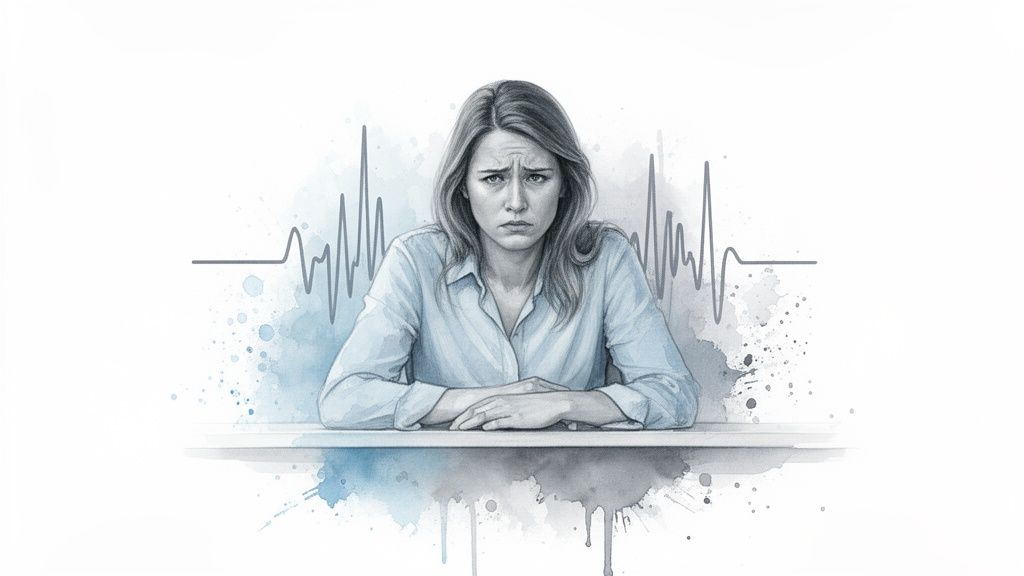
Meet Sarah. She is a successful project manager who, on the surface, has it all together. But underneath that professional exterior, she lives with a constant, low-grade sense of dread about upcoming deadlines and team meetings. She often loses sleep worrying about things that have not even happened.
Sarah's experience is a deeply human one. If you have ever felt that knot in your stomach before a big event or a racing heart for no clear reason, you are not alone.
According to the World Health Organization, anxiety disorders affected an estimated 301 million people globally in 2019. Despite how common this is, many who need help do not receive any form of treatment. You can see more about these global mental health trends on the WHO's website.
Fear And Anxiety Are Not The Same Thing
Before you can learn how to manage fear and anxiety, it is critical to know the difference. Think of these feelings not as character flaws but as signals from your body's internal alarm system. One is a fire alarm, the other is a smoke detector.
-
Fear is a direct response to an immediate, identifiable danger. It is that jolt you feel when a car suddenly swerves into your lane. It is primal, protective, and all about the now.
-
Anxiety is a response to a potential, future threat. It is the worry about what if a car swerves, even when the road is completely clear. Anxiety is more vague, future-focused, and often hangs around.
Here's a simple way to look at it:
Fear vs. Anxiety: A Quick Guide
This table helps you quickly distinguish between the related but distinct experiences of fear and anxiety.
| Characteristic | Fear | Anxiety |
|---|---|---|
| Trigger | Specific, immediate threat | Vague, potential future threat |
| Focus | Present moment | Future-oriented |
| Duration | Short-lived, subsides when danger passes | Can be long-lasting and persistent |
| Feeling | Intense, sharp, clear cause | Diffuse, nagging, unclear cause |
| Example | Seeing a bear on a hiking trail | Worrying about bears before the hike |
Both feelings trigger the body’s "fight-or-flight" response, a rush of adrenaline that prepares you to confront or escape danger. This is why you might get a pounding heart, shallow breathing, or tense muscles when you're anxious, even if there's no obvious threat in sight.
Understanding this biological process is the first empowering step. It reframes your experience from "something is wrong with me" to "my body is trying to protect me, but the alarm is too sensitive right now."
Recognizing these physical and emotional cues is a foundational part of emotional regulation. Building this skill is a journey, and a great place to start is by reading our guide on how to improve self-awareness. Grasping the "why" behind your feelings gives you a solid platform to build effective coping strategies.
Build a Foundation of Calm with Daily Routines
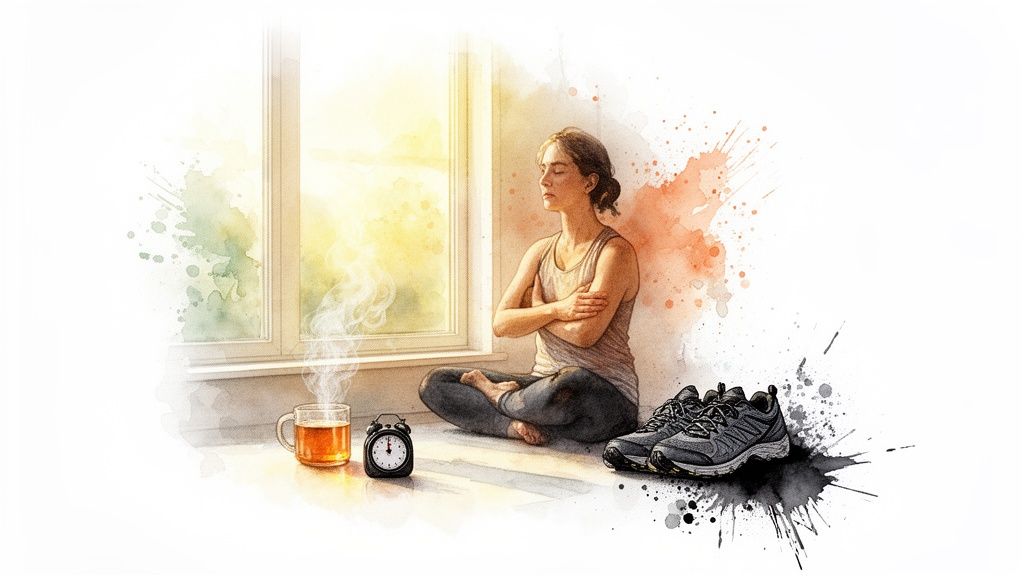
Knowing how your body’s alarm system works is one thing, but learning how to quiet it down is another. Real, lasting change rarely comes from one big, dramatic gesture. Instead, it is built through the small, consistent actions you take every day. This is where daily routines become your most powerful ally in the journey to overcome fear and anxiety.
Let's look back at Sarah, the project manager we met earlier. Drowning in a constant sense of dread, she decided to start small. Her only commitment was a simple five-minute breathing exercise each morning before even touching her phone. At first, it felt almost insignificant. But within a week, she noticed a subtle shift; the usual morning wave of worry felt just a little less intense.
This small win highlights a crucial point: you do not need a complete life overhaul. The real goal is to gently weave supportive habits into your day, focusing on four key pillars that help regulate your nervous system and build resilience from the ground up.
Master Your Breath to Master Your Mind
When anxiety kicks in, your breathing often becomes shallow and quick, which screams "danger!" to your brain. By consciously slowing down your breath, you can send a powerful message of safety right back to your nervous system. It is one of the fastest ways to interrupt the anxiety cycle in its tracks.
A simple yet profound technique to start with is Box Breathing:
- Inhale slowly through your nose for a count of four.
- Hold your breath gently for a count of four.
- Exhale slowly through your mouth for another count of four.
- Hold again at the bottom of the exhale for a count of four.
Repeat this cycle for just a few minutes whenever you feel that familiar tightness of anxiety creeping in. The rhythmic, predictable pattern gives your mind a single, peaceful point of focus.
Prioritize Restorative Sleep
Anxiety and poor sleep are tangled in a frustrating, vicious cycle. Worry keeps you staring at the ceiling, and the resulting exhaustion makes you even more vulnerable to anxiety the next day. Breaking this pattern requires creating a deliberate buffer between your busy day and your time for rest.
Instead of just hoping for better sleep, create a "wind-down hour." This is your non-negotiable time dedicated to calming activities that signal to your brain it's time to power down.
- Turn off screens: The blue light from phones and laptops messes with melatonin, the hormone that tells your body it's time to sleep.
- Engage in a quiet hobby: Pick up a physical book, listen to some calm music, or journal about your day to get thoughts out of your head.
- Sip herbal tea: Chamomile or lavender tea can have wonderfully soothing effects.
These are not just random tips; they are signals that tell your brain to switch off from problem-solving mode and prepare for deep, restorative rest. By building these habits, you're practicing good emotional hygiene, a set of daily habits for a clearer mind.
Move Your Body to Soothe Your Nerves
Physical activity is one of the most effective, non-pharmaceutical tools we have for managing anxiety. Movement helps burn off excess cortisol (the stress hormone) and releases endorphins, which are basically your brain's natural mood-lifters. You do not have to run a marathon; a simple 20-minute walk can make a world of difference.
Population studies consistently show that people who get regular physical activity have significantly lower odds of developing anxiety. For example, a 2024 analysis of UK Biobank data found that higher levels of physical activity were associated with lower anxiety scores. The connection is undeniable: moving your body has a direct, positive impact on your mental state. You can read more about the link between activity and lower anxiety scores in UK population data.
The key is to find movement you actually enjoy. It could be dancing in your living room, stretching, gardening, or walking your dog. The goal isn't a punishing workout; it's intentional, mindful movement that helps you get out of your head and back into your body.
Fuel Your Brain with Supportive Nutrition
What you eat directly impacts your brain function and, by extension, your mood. While no single food is a magic cure for anxiety, some choices can either aggravate your symptoms or help soothe them.
- Limit Caffeine and Sugar: These can cause energy spikes and crashes that feel uncomfortably similar to the physical sensations of a panic attack, which can trigger more worry.
- Focus on Whole Foods: Think of a balanced diet rich in vegetables, fruits, lean proteins, and healthy fats as providing the essential building blocks your brain needs to function at its best.
- Stay Hydrated: Even mild dehydration can tank your mood and make it harder to cope with stress. Keep a water bottle handy.
Making small, sustainable swaps in your diet contributes to a more stable emotional foundation. Start by trading one sugary soda for a glass of water or adding a handful of leafy greens to your lunch. Each small, positive choice reinforces your foundation of calm.
Rewire Anxious Thoughts with Practical Mind Tools
While daily routines build a solid physical foundation for calm, the real work often happens inside your mind. Anxiety can feel like an unwelcome narrator in your head, constantly spinning stories of future disaster. The good news? You have the power to challenge and rewrite that internal script.
This is where evidence-based approaches like Cognitive Behavioral Therapy (CBT) and Acceptance and Commitment Therapy (ACT) come into play. You do not need to be a therapist to use their core principles. Think of them as practical mind tools designed to help you change your relationship with your thoughts.
Let's check back in with Sarah, our project manager. A huge presentation is looming, and her mind is spiraling. "I'm going to forget everything," she thinks. "Everyone will see I'm a fraud, and my career will be over." This is not just a fleeting worry; it's a destructive thought pattern that feels incredibly real. But with a few simple techniques, she can learn to dismantle this fear.
Identify Your Common Thinking Traps
Anxious thoughts often follow predictable, unhelpful patterns called cognitive distortions, or "thinking traps." They are like mental shortcuts your brain takes that warp reality and amplify fear. Learning to spot them is the first step toward disarming them.
Here are a few common ones you might recognize:
- Catastrophizing: This is the "what if" trap on overdrive. You jump to the worst possible conclusion, imagining a minor setback will trigger a chain reaction of disaster. For a student, this might sound like, "If I get a C on this exam, I'll fail the class, lose my scholarship, and have to drop out."
- Black-and-White Thinking: Also known as all-or-nothing thinking, this trap sees everything in extremes. If you are not a complete success, you are a total failure. A professional might think, "If I do not get this promotion, it means my entire career has been pointless."
- Mind Reading: You assume you know what others are thinking, and it is almost always negative. For example, "My boss was quiet in that meeting; she must think my ideas are terrible." You jump to this conclusion without any actual evidence.
Recognizing these patterns in your own internal monologue is a game-changer. It allows you to see the thought for what it is: a distorted product of anxiety, not objective fact.
Challenge Your Thoughts with a Thought Record
Once you can spot a thinking trap, the next step is to actively challenge it. A Thought Record is a simple but powerful CBT exercise that helps you do just that. It is like becoming a detective for your own mind, gathering evidence to see if your anxious thoughts hold up under scrutiny.
Let’s see how Sarah can use this tool to tackle her presentation fears.
This simple table shows how to break down a powerful anxious thought, question its validity, and replace it with something more grounded in reality.
Cognitive Reframing in Action
| Anxious Thought (Cognitive Distortion) | Challenge Question | Balanced Reframe |
|---|---|---|
| "I'm going to forget everything and humiliate myself. Everyone will think I'm a fraud." (Catastrophizing) | "What's the evidence for this? Have I forgotten everything in past presentations? What's a more likely outcome?" | "I feel nervous, but I've prepared well. I might stumble on a word or two, but that's normal. My team is supportive, and they know my work is solid." |
| "If this presentation isn't perfect, my career is over." (Black-and-White Thinking) | "Is it true that one single presentation defines my entire career? What have I accomplished so far?" | "This presentation is important, but it's just one part of my job. A single performance doesn't erase all my past successes. I'll do my best, and that's enough." |
By writing it down, Sarah forces herself to slow down and evaluate her fears logically. The goal is not to pretend the anxiety does not exist. It is about finding a more realistic, balanced perspective that reduces its power over you.
Create Distance with Cognitive Defusion
While CBT helps you challenge the content of your thoughts, ACT offers a different approach called cognitive defusion. Instead of fighting with a thought, you learn to step back and observe it without getting tangled up in it. You create distance.
The core idea is simple: You are not your thoughts. Thoughts are just mental events, like clouds passing in the sky. You can notice them without letting them control you.
One of the most effective ways to practice this is by changing your language. When an anxious thought appears, just add a simple phrase to the beginning.
Instead of thinking, "I'm going to fail," try saying to yourself, "I'm having the thought that I'm going to fail."
This subtle shift in wording creates a small but crucial gap between you and the thought. It transforms the thought from an undeniable fact into a temporary mental event you are simply observing. It immediately loses some of its grip.
Here are a few other defusion techniques to try:
- Thank Your Mind: When your brain offers up a classic worry, you can mentally say, "Thanks, mind, for that thought!" This acknowledges the thought with a bit of humor and lightness, reinforcing that you're in charge, not the anxiety.
- Give It a Name: You can even label your anxiety's narrative. For instance, "Ah, there's my 'I'm Not Good Enough' story again." Naming it makes it feel more like a predictable, recurring character rather than an all-powerful truth.
These mind tools are skills that strengthen with practice. By consistently identifying, challenging, and creating distance from your anxious thoughts, you begin to rewire your brain's default pathways. You learn how to overcome fear by changing the very way you relate to your own mind.
Gently Face Your Fears Instead of Avoiding Them
It is a perfectly human instinct to sidestep situations that trigger fear. Why walk into a room that makes your heart pound when you could just stay home? Avoiding what scares us provides immediate, blissful relief, but it comes at a cost.
Over time, that avoidance does not shrink the fear; it feeds it. Your world gets smaller and smaller.
The more you dodge something, the more you reinforce your brain's belief that it is a genuine threat. This cycle strengthens anxiety until it feels unbreakable. The only way to break this pattern is to gently and gradually face those situations instead of running from them. This process, known as exposure, is about building confidence, not enduring torture.
The Power of the Fear Ladder
Think of it like climbing a ladder. You do not start by leaping to the top rung. Instead, you begin on the lowest, most manageable step and only move up when you feel ready. This self-guided process puts you entirely in control.
Let's imagine someone with social anxiety whose ultimate goal is to attend a big networking event without feeling overwhelmed. That is the top of their ladder. The bottom rungs might look something like this:
- Step 1: Make brief eye contact with a cashier and say "thank you."
- Step 2: Give a genuine compliment to a stranger at a coffee shop.
- Step 3: Ask a coworker a simple, non-work-related question.
- Step 4: Stay at a low-key social gathering for just 15 minutes.
- Step 5: Initiate a short conversation with someone new at that gathering.
- Step 6: Attend the networking event with the goal of just listening.
- Step 7: Attend the networking event and speak to one new person.
Each step is a small victory. By starting with tasks that feel only slightly uncomfortable, you build momentum. The key is to celebrate every single rung you climb. If you're looking for more ways to build this kind of confidence, our guide on overcoming social anxiety is a great place to start.
This three-step process shows how you can manage your thoughts during these moments of exposure.
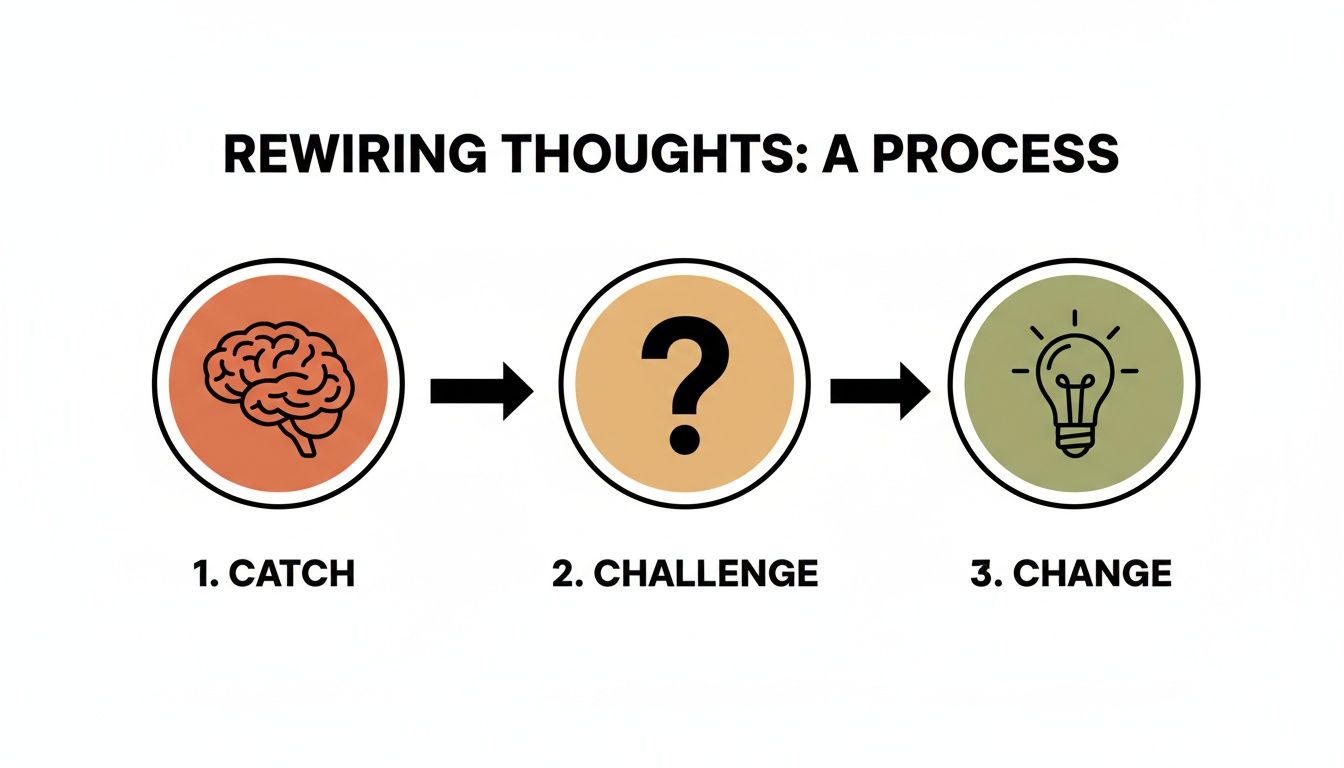
This simple flow, Catch, Challenge, Change, shows that you can actively interrupt anxious thought cycles. You first notice them, then question their validity, and finally replace them with a more balanced perspective.
Understanding the Science of Habituation
So, why does this actually work? It is rooted in a biological principle called habituation.
When you stay in a feared situation long enough, without the terrible outcome you predicted, your brain starts to get bored. The initial alarm bells of anxiety begin to quiet down because the anticipated disaster never arrives.
You are teaching your nervous system a new lesson through direct experience. With each small exposure, you provide your brain with fresh evidence that the situation is safe. This is far more powerful than just telling yourself "there's nothing to be afraid of."
Research consistently shows that exposure-based therapies produce some of the most durable reductions in fear. This is not just theory. A 2021 study published in The Lancet highlighted the sharp increase in global anxiety cases following the COVID-19 pandemic, reinforcing the need for accessible strategies like guided exposure to manage these widespread challenges.
Courage is not the absence of fear. It is taking action despite the presence of fear. Each step you take up your fear ladder, no matter how small, is an act of profound courage that rewires your brain for confidence.
This gentle, controlled approach allows you to prove to yourself, one step at a time, that you can handle far more than your anxiety wants you to believe. It is a powerful way to reclaim your life from the grip of avoidance.
Anchor Yourself in the Present with Grounding Practices

When a wave of fear or anxiety hits, it can feel like you are being swept out to sea. Your mind gets tangled in future worries, pulling you far away from the safety of the present moment. In those intense seconds, you do not need a complex strategy; you need an anchor. Right now.
This is where grounding practices come in. These are simple, potent techniques designed to pull your awareness out of the storm in your head and back into the physical reality of the here and now. They work by engaging your five senses to interrupt the panic spiral and remind your nervous system that you are fundamentally safe.
Use Your Senses with the 5-4-3-2-1 Method
One of the most effective and easy-to-remember grounding techniques is the 5-4-3-2-1 method. The beauty of it is that it is discreet enough to do anywhere, from a busy office meeting to a crowded bus, without anyone knowing. It forces your brain to switch gears from abstract worry to concrete observation.
All you have to do is pause and gently notice:
- 5 things you can see: Look around and name five objects. Notice their color, shape, and texture without judging them. It could be a pen on your desk, a crack in the ceiling, or a single leaf fluttering outside the window.
- 4 things you can feel: Bring your awareness to physical sensations. This could be the texture of your jeans, the solid ground beneath your feet, or the smooth, cool surface of your phone.
- 3 things you can hear: Listen closely to the sounds in your environment. Can you pick out the hum of a computer, the sound of distant traffic, or even just your own quiet breathing?
- 2 things you can smell: What scents are in the air? Maybe it is the faint aroma of coffee from the kitchen or the clean smell of soap on your hands.
- 1 thing you can taste: Focus on the single sensation of taste. You could take a small sip of water, pop a mint in your mouth, or simply notice the lingering taste inside your mouth.
This sensory checklist acts as a circuit breaker for overwhelming thoughts. It guides you back into your body and the present moment, which is a vital skill when learning how to manage fear and anxiety as it happens.
Interrupt the Spiral with Temperature and Touch
Sometimes, a simple sensory scan is not enough to cut through intense panic. When you need a stronger interruption, using temperature and touch can be incredibly effective. The goal is to give your brain a new, powerful physical sensation to latch onto instead of the fear.
Intense physical sensations, like the shock of cold, can effectively hijack the brain's attention away from a panic spiral. This provides a critical window of opportunity to regain control of your breathing and thoughts.
One potent technique is to simply hold a piece of ice. The sharp, cold sensation is difficult for your brain to ignore. As you hold it, focus all of your attention on how it feels in your hand, the way the water drips, and the feeling as it slowly melts. This intense physical focus can stop a mounting panic attack in its tracks.
Another powerful anchor is the feeling of your feet on the floor. Whether you're sitting or standing, press your feet firmly into the ground. Notice the solid, unmoving support beneath you. Wiggle your toes inside your shoes. This simple action connects you to the earth and reinforces a sense of stability when you feel emotionally unsteady. Think of these as practical, immediate tools for your mental health toolkit.
Knowing When to Reach Out for Professional Support
While the self-help strategies in this guide are incredibly powerful for managing and reducing fear, it is also crucial to recognize when they might not be enough. Learning how to overcome fear and anxiety sometimes means having the courage to ask for help.
Seeking support is not a sign of failure. In fact, it is a proactive and powerful act of self-care. You do not have to navigate this journey all on your own.
Signs It Might Be Time to Talk to a Professional
If you find that anxiety is consistently getting in the way of your life, it may be time to reach out. Consider professional support if you experience the following:
- Daily Functioning is Disrupted: Your anxiety makes it difficult to perform at work, succeed in school, or maintain your relationships.
- Frequent Panic Attacks: You experience sudden, overwhelming episodes of intense fear that feel debilitating and out of your control.
- Reliance on Unhealthy Coping: You find yourself using alcohol, avoidance, or other harmful behaviors to manage your feelings.
- You Feel Stuck: Despite trying self-help techniques, your anxiety isn't improving or continues to worsen over time.
Think of a therapist as a skilled guide or a personal trainer for your mind. They can provide a safe space and offer structured, evidence-based tools to help you build resilience.
Therapies like Cognitive Behavioral Therapy (CBT) and Acceptance and Commitment Therapy (ACT) are highly effective for anxiety. They offer structured approaches to help you reframe thoughts and change behaviors. A professional can help you choose the right path for your specific needs.
Answering Your Questions About Overcoming Anxiety
As you start this journey of managing fear and anxiety, it is completely normal for questions to pop up. You might wonder how long it will take to feel a real difference or what on earth to do when a wave of panic hits. Let’s tackle some of the most common questions we hear.
The path to managing anxiety looks different for everyone. There is no magic "cure" or a set timeline. Instead, think of progress in small, meaningful moments, like using a grounding technique to get through a stressful meeting or catching an anxious thought before it spirals.
How Long Does It Take to Feel Better?
This is the big question, is not it? And the honest answer is: it varies. How quickly you feel better depends on things like how consistently you practice these tools, the intensity of your symptoms, and what is going on in your life. Some people start to notice small, positive shifts within a few weeks.
For others, it is a more gradual process unfolding over several months. The goal is not to erase all anxiety overnight; that is not realistic. The real aim is to build a reliable set of skills you can turn to when you need them most. Progress is not a straight line. You will have good days and tougher ones, and that is a completely normal part of healing.
Focus on consistent effort, not immediate perfection. The real wins are the small victories—making it through a situation you used to avoid or gently challenging a negative thought. These are the building blocks of lasting change.
What If I Have a Panic Attack?
First, remember this: panic attacks feel absolutely terrifying, but they are not dangerous, and they always pass. The moment you feel one coming on, the key is to try not to fight it. Fighting it just adds more fuel to the fire. Instead, your goal is to anchor yourself in the present moment with a grounding technique.
Here's a quick plan of action:
- Breathe it out: Focus on slow, deep breaths. This sends a signal to your nervous system that you're safe.
- Use a strong sensation: Splash cold water on your face or hold an ice cube in your hand. The intense feeling can jolt you back to the present.
- Try the 5-4-3-2-1 method: Name five things you can see, four you can touch, three you can hear, and so on.
Remind yourself that the intense physical feelings are just your body's alarm system going haywire. It is a false alarm. By practicing these techniques, you learn to ride the wave of panic instead of being swept away by it. This is a crucial skill for taking back control from fear and anxiety.
At fineliving Soul, we believe that understanding your inner world is the key to living a purposeful life. We offer practical, compassionate guidance to help you build healthier habits and find lasting peace. To discover more actionable strategies, visit us at finelivingsoul.com.
Article created using Outrank


