


It often starts so subtly you might not even notice it. At first, it just feels a little off, less like a true partnership and more like a solo performance. The clearest signs of a one sided relationship show up as a persistent imbalance in effort. You’re the one who consistently initiates contact, makes the plans, and provides emotional support, but you get very little back in return.
This pattern can leave you feeling completely drained and deeply undervalued.
What a One Sided Relationship Looks Like

Does this sound familiar? You’re always the one to send the first text, your thumb hovering over the screen, waiting for a reply that takes hours, or sometimes never comes. You’re the one suggesting dinner, picking the restaurant, and making the reservation.
When your partner has a bad day, you drop everything to be their anchor, offering a listening ear and endless comfort. But when your own world feels heavy, that support is mysteriously gone. This isn’t just an off week; it’s the very rhythm of your relationship.
A one-sided relationship is a connection where one person invests a disproportionate amount of energy, time, and emotion. It’s like you’re paddling a canoe for two, putting in all the work, while the other person just sits back and enjoys the ride.
Over time, this imbalance quietly chips away at your self-worth. You start to question if you’re asking for too much, or worse, if you’re simply not enough to deserve the same effort in return.
This dynamic is a breeding ground for resentment and emotional exhaustion. It’s an incredibly lonely place to be, making you feel more like a caretaker or an event planner than a cherished partner. Recognizing this pattern is the first critical step toward reclaiming your peace. It’s vital to see the difference between a temporary slump and a chronic imbalance, as the latter can be one of the more damaging red flags in relationships you should never ignore.
Quick Guide to Spotting an Imbalanced Relationship
To help you get a clearer picture, sometimes it’s useful to see the signs laid out plainly. An imbalance isn’t always about one big, dramatic event. More often, it’s a series of small, consistent actions that reveal a larger pattern of neglect. Think of it as connecting the dots to see the full image of your relationship’s health.
The summary table below outlines some of the most common signs of a one-sided dynamic. Use it as a quick diagnostic tool to see if these behaviors feel uncomfortably familiar.
| Common Sign | What It Looks Like in Daily Life |
|---|---|
| Unequal Effort | You are always the one initiating texts, calls, and plans. |
| Emotional Unavailability | Your partner dismisses your feelings or is absent during your times of need. |
| One-Way Support | You are their go-to support system, but the favor is rarely returned. |
| Future Avoidance | They avoid conversations about long-term commitment or making plans. |
| Constant Excuses | You find yourself constantly justifying their neglectful behavior to others and yourself. |
Seeing these patterns written down can be a powerful reality check, moving the issue from a vague feeling of unhappiness to a concrete problem you can finally address.
You Always Initiate Contact and Make the Plans

Take a quick look at your phone. If you scrolled through your texts and calls with this person, what would the pattern reveal? One of the most glaring signs of a one-sided dynamic is realizing you are the engine keeping the connection running.
You’re the one sending the first “Good morning” text, making the “How was your day?” call, or suggesting plans for the weekend. Your partner, on the other hand, rarely reaches out first. This isn’t just about who texts first; it’s about who carries the emotional and logistical weight of keeping the relationship alive and moving forward.
This imbalance can quietly chip away at you. Over time, you might start to feel less like a cherished partner and more like a persistent applicant, constantly working just to get their attention. It’s a lonely feeling that can make you question your own value in the relationship.
The Story of the Constant Initiator
Consider Maya’s story. For months, she couldn’t shake a feeling of unease. She loved her partner, but she was also deeply tired. One evening, after she planned yet another date night that he passively agreed to, she decided to try a little experiment.
She just stopped. She didn’t send the morning text. She didn’t call after work. She didn’t bring up plans for the weekend. The silence was immediate and deafening. Three whole days passed without a single message from him. When he finally did reach out, it was with a casual, “Hey, what’s up?” as if nothing was out of the ordinary.
For Maya, that silence confirmed everything she had suspected. She was the one holding it all together, and the moment she stopped putting in the effort, the relationship simply stalled. This goes deeper than different communication styles; it is a clear signal of unequal investment.
This kind of imbalance is a hallmark of one-sided relationships and reflects a broader trend of modern disconnection. A 2023 survey by the Survey Center on American Life revealed that nearly half of Americans (49%) have three or fewer close friends, highlighting a growing sense of isolation. This gap is felt acutely when the person you’re supposed to be closest to feels distant. You can explore more insights on social connection trends to see how these patterns play out on a larger scale.
The Two-Week Communication Audit
A vague feeling of imbalance is hard to address, but concrete data is impossible to ignore. To get clarity, try a simple two-week tracking exercise. This isn’t about scorekeeping or gathering ammunition for a fight; it’s for your own understanding.
For the next 14 days, keep a simple log. Note down every time you initiate contact and every time they do.
- Who sent the first text of the day?
- Who made the call just to check in?
- Who first brought up making plans for the week?
- Who followed up to confirm details?
After two weeks, look at what you’ve written down. The pattern will likely be crystal clear, giving you an undeniable picture of the communication dynamic. This clarity is the first real step toward understanding the balance of effort in your relationship and deciding what to do next.
Your Emotional Needs Are Consistently Overlooked

While an uneven split in chores or planning is a visible sign of imbalance, the emotional side of things is often far more painful and harder to pin down. This isn’t about grand romantic gestures or forgotten anniversaries. It’s about the quiet, daily experience of feeling completely invisible in your own relationship.
This is one of the most damaging signs of a one sided relationship because it cuts right to the heart of what a partnership should be: a safe harbor for mutual support. When your emotional needs are consistently ignored, you end up feeling more alone with your partner than you ever would by yourself.
Picture this: you’ve had an absolutely draining day at work. You finally get a moment to connect with your partner, hoping for a little understanding. But as you start to open up, you see their eyes glaze over while they scroll through their phone. Or maybe they cut you off to steer the conversation back to their own day. Sound familiar?
The Foundation of Emotional Reciprocity
This kind of dismissal is a major red flag. A healthy relationship is built on a foundation of emotional reciprocity, the natural give-and-take of empathy, validation, and support. It’s the unspoken promise that you’ll be there for each other, through thick and thin.
When that reciprocity disappears, the relationship turns into an emotional desert for one person. It becomes a place where your vulnerability is met with a cold shoulder, and your feelings are treated like an inconvenience. Over time, this emotional neglect can chip away at your self-esteem, making you second-guess whether your feelings are even valid.
This isn’t just a bad habit; it’s a profound form of disrespect. It sends a clear signal that your inner world just doesn’t matter to them. When one person consistently fails to show up emotionally, the connection becomes hollow, leaving the other to carry all the emotional weight alone.
In a secure relationship, both partners are mutually committed to meeting each other’s needs. If you have clearly expressed your needs and consistently attended to your partner’s, yet find your own are repeatedly ignored, it’s a sign that the fundamental contract of care has been broken.
Subtle Signs of Emotional Dismissal
Emotional neglect isn’t always loud or dramatic. It often hides in the small, everyday moments that, when added up, create a pattern of deep loneliness. Learning to spot these subtle behaviors is the key to understanding what’s really going on.
Here are a few common ways emotional dismissal shows up:
- The Phone Wall: They’re constantly scrolling through social media, watching videos, or checking emails while you’re trying to have a real conversation. The message is loud and clear: their screen is more interesting than you are.
- The Topic Hijack: You start sharing something important, and somehow, they always manage to make the conversation about themselves: their problems, their experiences, their day.
- The Minimizer: When you express that you’re hurt or frustrated, they shut you down with phrases like, “You’re being too sensitive,” or “It’s not a big deal.” This invalidates your feelings and kills communication.
- The Absence During Crisis: When you’re genuinely going through a tough time, a family issue or personal stress, they offer no real support, comfort, or even a listening ear.
These behaviors might seem small in isolation, but together they paint a clear picture of a one-sided emotional investment.
Reflective Prompts to Assess Your Connection
To get some clarity, it can help to shift your focus from their behavior to your own feelings. The way you answer these questions can tell you a lot about the emotional safety in your relationship.
Take a quiet moment and honestly reflect on these prompts:
- Do I feel emotionally safe enough to be vulnerable with my partner?
- When was the last time they asked about what I was going through and truly listened without distraction?
- Do I often find myself downplaying my own feelings to avoid making them uncomfortable or annoyed?
- After sharing something personal, do I usually feel more connected to them, or even more alone?
Answering these honestly can be a powerful reality check. A healthy partnership should make you feel seen, heard, and valued. If you consistently feel invisible, it’s a painful but clear sign of a deeply one-sided relationship.
Your Partner Avoids Talking About the Future
Imagine you and your partner are in a rowboat together. You’re rowing hard, eyes fixed on a destination you both supposedly want to reach. But when you glance over, your partner has their oars out of the water. They’re just along for the ride, maybe even admiring other shores, completely unbothered about where you’re headed.
This feeling captures one of the most painful signs of a one-sided relationship: your partner consistently dodges any real conversation about the future. It’s a quiet, heavy clue that your long-term goals just don’t line up, leaving you to carry the weight of your shared dreams all by yourself.
This isn’t about rushing into marriage or mapping out the next decade. A healthy relationship moves at a pace that feels right for both people. The problem is when there’s a flat-out refusal to even discuss what comes next. It creates a dynamic where one person is all in, while the other has one foot out the door.
The Difference Between Pace and Avoidance
It’s so important to tell the difference between a partner who just needs more time and one who is actively avoiding commitment. One is about timing; the other is about intent. A partner who is committed but cautious will still talk about the future, even if they aren’t ready for the next big step right this second.
But a partner who is fundamentally uncommitted will shut these conversations down, again and again.
- Dodging the Question: When you bring up moving in or meeting their family, do they skillfully change the subject or give you a vague answer that means nothing?
- Hesitation with Introductions: Are they reluctant to introduce you to their close friends or parents, keeping you separate from the core parts of their life?
- Solo Life Decisions: Do they make huge life choices, like taking a job in another city or buying a car, without even talking it over with you first?
These aren’t small oversights. They signal a deep lack of investment in a shared future. You’re being treated like a temporary chapter in their life, not a permanent co-author. This dynamic is known as asymmetrical commitment, where one person is ready to build something lasting while the other holds back, creating a foundation that’s bound to crumble.
This isn’t just a feeling; it’s a well-documented and damaging pattern. A study published in the Journal of Social and Personal Relationships involving over 300 heterosexual couples found that men in asymmetrically committed relationships reported lower satisfaction, while women reported greater depressive symptoms. The study showed these relationships had lower quality, more conflict, and poorer well-being. You can read more about these relationship dynamics and their impact on couples.
A Story of Mismatched Timelines
Consider Alex and Jamie. Alex was ready for the next step and would often bring up the idea of them getting a place together. Each time, Jamie would deflect with lines like, “We have so much time for that,” or “Let’s just enjoy where we are right now.”
At first, Alex was patient, trying to respect Jamie’s pace. But after a year of the same non-conversation, a clear pattern had formed. Jamie wasn’t just “taking things slow.” Jamie was actively avoiding any real commitment. The moment of truth came when Jamie signed another year-long lease on a solo apartment without so much as a heads-up. The message was crystal clear: Jamie’s future didn’t include a “we.”
When a partner consistently refuses to plan a future with you, they are communicating their intentions through inaction. Believing their actions over their occasional reassuring words is crucial for protecting your own heart.
A Private Commitment Assessment
If you’re feeling uncertain about where your relationship is headed, it’s time for some clarity. This isn’t about keeping score or building a case against your partner. It’s a private tool to help you honestly gauge the balance of commitment.
Take a quiet moment and reflect on these questions.
- When I talk about the future (like a vacation next year or holiday plans), does my partner engage with excitement or do they seem uncomfortable and shut down?
- Have I met the people who are most important in my partner’s life, like their family and closest friends?
- Does my partner ever include me in conversations about their long-term financial or career plans?
- When we talk about possibilities, do we naturally use words like “we” and “us,” or does my partner almost always stick to “I” and “me”?
Answering these can bring a painful but necessary truth to the surface. If your partner is consistently unwilling to plan a future with you, you might be rowing with all your might toward a destination they never intended to reach.
You Find Yourself Constantly Making Excuses for Them
One of the most telling signs you’re in a one-sided relationship is when you become your partner’s unofficial publicist. You find yourself constantly explaining away their thoughtless behavior, not just to your friends and family, but even to yourself. This pattern of rationalizing is a quiet defense mechanism, a way to protect your heart from a painful truth.
It often starts with small justifications. “They’re just swamped at work right now.” “They’re not a big texter, it’s just how they are.” “They had a rough week, so of course they forgot.” Empathy is one thing, but there’s a sharp line between showing understanding for an off day and creating a non-stop narrative that lets your partner off the hook for everything.
When you constantly make excuses, you are actively lowering your standards in real-time to match their lack of effort. This isn’t just giving them the benefit of the doubt; it’s systematically ignoring what you need to keep the peace.
The Psychology of Justification
So, why do we fall into this trap? When someone’s actions don’t line up with the idea we have of them in our heads, it creates a mental discomfort called cognitive dissonance. To get rid of that uncomfortable feeling, it’s often easier to invent an excuse for their behavior than to face the harsh possibility that they just don’t care as much as you do.
You become a storyteller, spinning tales that paint their indifference in a much more flattering light. This impulse is often tied to a deep-seated fear of conflict and a need to be agreeable. If this pattern feels familiar, you might want to explore how it connects to people-pleasing. We have a guide that can help you learn more about how to stop being a people-pleaser.
When you have to regularly explain your partner’s lack of care to yourself or others, you are no longer in a partnership. You have become the sole manager of a relationship that exists mostly in your own efforts.
From Understanding to Excusing
Knowing the difference between genuine understanding and chronic excuse-making is everything. One builds connection, while the other enables neglect. Understanding is temporary and tied to a specific situation, while excusing becomes a permanent, draining pattern.
Here are some of the most common justifications that signal you’ve crossed that line:
- “They’re just not a very emotional person.” This is a classic line used to dismiss a partner’s complete lack of emotional support or affection. Yes, people express emotions differently, but a total absence of care isn’t a personality quirk. It’s a sign of disconnection.
- “They show their love in other ways.” While everyone has different love languages, this excuse is often a way to ignore the fact that your core needs for communication, quality time, or affection are going completely unmet.
- “Their past relationships were really bad.” A tough history can explain certain behaviors, but it should never be a permanent get-out-of-jail-free card for treating you poorly. A healthy partner takes responsibility for their own healing, not uses their past as a weapon.
- “At least they’re not [doing something worse].” Comparing your partner’s behavior to a worse hypothetical is a trick your mind plays to minimize the real hurt you’re feeling right now. You deserve a partner who is actively good for you, not just “not that bad.”
Recognizing these excuses in your own thoughts is the first, most powerful step toward reclaiming your self-respect. It’s about deciding that your feelings are valid and that you deserve a partner whose actions don’t require constant defense.
How To Address The Imbalance In Your Relationship
Realizing you’re in a one-sided relationship is the first, often painful, step. But moving from that awareness to actually doing something about it takes a special kind of courage and a clear plan. The goal isn’t to start a fight or deliver an ultimatum. It’s about discovering whether balance is even possible. And if it’s not, the goal becomes finding the strength to put your own well-being first.
This whole process doesn’t start with your partner; it starts with you. Before any productive conversation can happen, you need to get crystal clear on what you’re feeling, what you need, and what you’re no longer willing to put up with. This quiet self-reflection is the bedrock of any real change.
Clarify Your Needs And Boundaries
Set aside some time to think about what a healthy partnership actually looks and feels like to you. What specific things would make you feel seen, valued, and supported? Try to move from vague feelings like “I feel ignored” to concrete needs like, “I need us to plan one date night a week together,” or “I need you to ask about my day and actually listen without being on your phone.”
This is also where you identify your non-negotiables. These are the absolute core requirements you have to feel safe and respected. Setting these limits is non-negotiable for your emotional health. For some practical guidance, you can explore how to create healthy emotional boundaries in relationships to start building that stronger sense of self.
Initiate A Calm, Constructive Conversation
Once you have that clarity, it’s time to talk. The key here is to keep the conversation calm and avoid an accusatory tone. You’re trying to express your feelings and invite them to help find a solution, not put them on the defensive right away.
One of the best tools for this is using “I-statements.” This simple shift in language lets you own your feelings without pointing fingers.
Instead of: “You never listen to me.”
Try: “I feel hurt and unimportant when I’m talking and you’re on your phone.”
Instead of: “You never make an effort to plan anything.”
Try: “I feel overwhelmed and lonely when I have to carry the mental load of planning all our time together.”
A relationship can only be repaired if both people are willing to show up, listen, and take accountability. The initial conversation is less about finding an immediate solution and more about gauging their willingness to even try.
Observe Their Response Carefully
Your partner’s reaction to this conversation will tell you everything you need to know about the future of your relationship. Seriously. Their response is the single most important sign of whether change is even possible.
To help you see the difference, this table breaks down how a partner in a healthy relationship might respond versus someone who keeps the one-sided dynamic going.
Healthy Communication vs. One-Sided Dynamics
| Scenario | Healthy Reciprocal Response | One-Sided Response Pattern |
|---|---|---|
| You express feeling unheard. | “I’m so sorry you feel that way. I didn’t realize I was doing that. What can I do to be more present?” | “You’re too sensitive. I was just checking one thing.” (Defensiveness, Dismissal) |
| You ask for more help with chores. | “You’re right, I haven’t been pulling my weight. Let’s make a clear plan for how we can divide things up.” | “I had a really long day at work. I’ll get to it later.” (Excuses, Deflection) |
| You bring up feeling lonely. | “That’s the last thing I want you to feel. I’ve been so caught up. How about we plan a date for this weekend?” | “Why didn’t you just say something sooner instead of getting upset?” (Blame-shifting) |
| You set a new boundary. | “Okay, I understand. I might forget at first, but I’ll do my best to respect that. Thank you for telling me.” | “You’re trying to control me. That’s not fair.” (Manipulation, Gaslighting) |
These patterns aren’t just about a single bad day; they reveal a fundamental difference in willingness to engage. One side is open to partnership, while the other is focused on protecting their own comfort.
Are they willing to listen, show empathy, and take some responsibility? Or do they get defensive, dismiss your feelings, or try to flip the blame back onto you? The decision tree below helps visualize the critical difference between a partner who offers genuine understanding and one who just makes excuses.
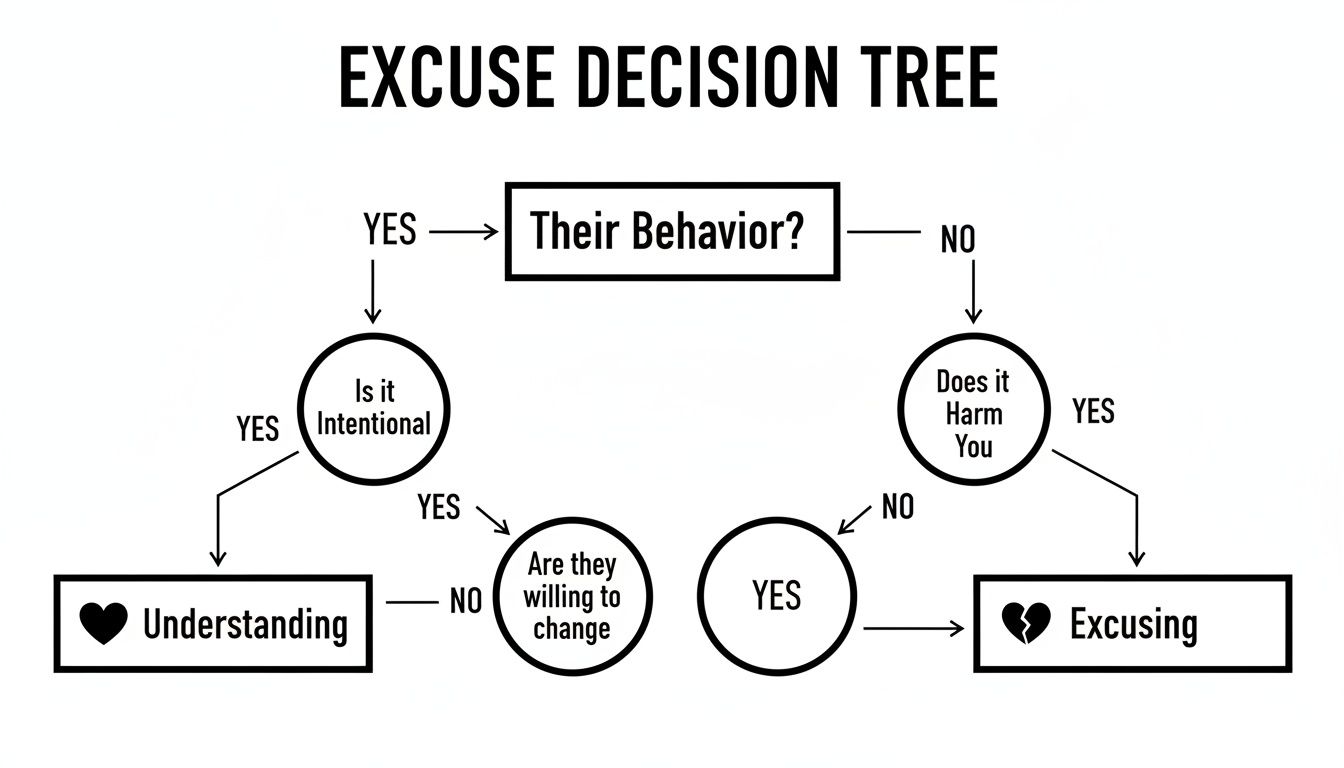
This distinction is everything. Understanding leads to connection and problem-solving. Excusing just gives them a pass to continue the neglect.
A healthy partner might not nail it right away, but they will show a real desire to see things from your side. An unwilling partner will make it obvious that your feelings are an inconvenience. Pay close attention to their actions, not just their words, in the days and weeks that follow. Real change shows up in consistent behavior, not in a single, well-worded apology.
Your Questions Answered: Navigating One-Sided Relationships
When you’re stuck in an imbalanced relationship, your mind is often flooded with tough questions and a whole lot of self-doubt. It’s completely normal to feel uncertain when the reality of your partnership doesn’t line up with what you’d hoped for.
Let’s clear up some of the most common worries people have in these situations. Getting some clarity here can help you start trusting your own feelings again and move from a place of confusion to a place of empowered action.
Can a One-Sided Relationship Be Fixed?
Yes, it’s possible, but the outcome depends almost entirely on one thing: the less-invested partner’s genuine willingness to change. The first step is always an open, honest conversation where you clearly and calmly state what you need.
If your partner really hears you, acknowledges the imbalance, shows true remorse, and, this is the most important part, takes consistent, sustained action to contribute equally, then you have a real reason for hope.
However, if they get defensive, dismiss your feelings, or make a few temporary changes only to slide back into old habits, that’s a huge red flag. It’s a strong sign the dynamic is too ingrained for them to fix. Real, lasting change requires their full commitment, not just yours.
Am I Being Too Needy or Are My Expectations Too High?
This is probably the most common fear that keeps people trapped in unhealthy dynamics. It’s so important to learn the difference between having fundamental needs and being “needy.”
Expecting mutual respect, shared effort, and emotional support aren’t high expectations. They are the bare minimum for a healthy partnership. If you’re asking for someone to meet you halfway, you are not being needy. You are asking for the very foundation of a real relationship.
When you feel like you have to prove your worth to someone, it is time to walk away. A healthy partner will see your value without you needing to audition for their affection and respect.
What If My Partner Is Just an Introvert or Communicates Differently?
While personality differences are absolutely real and valid, they should never be used as a blanket excuse for a consistent lack of effort. An introvert is perfectly capable of planning a thoughtful date night or sending a meaningful text to show they care. Someone with a “different communication style” isn’t excused from communicating at all.
The real question isn’t about their personality type; it’s about their effort. Do they make a consistent attempt to meet your needs and show you they value the relationship in a way you can actually feel? If their “style” consistently leaves you feeling lonely, ignored, and doing all the work, it’s a problem that goes much deeper than simple personality traits.
At fineliving Soul, we provide practical, compassionate guidance to help you build healthier relationships and cultivate inner peace. For more insights on recognizing your worth and fostering balanced connections, explore our resources at https://finelivingsoul.com.


